

Mars’ atmosphere is 100 times thinner than Earth’s. It’s mostly carbon dioxide with an overwhelming percentage of 95% of the total atmosphere, followed by Nitrogen with 2.7%. Oxygen on the other hand is only 0.13% of the atmosphere. There has also been records of minor water percentages
The soil on Mars is regolith and toxic due to the existence of Perchlorate (ClO-4) in its composition. Despite that, many researchers suggest that Martian soil has some of the necessary nutrients for plant’s survival. Nasa’s Mars rover Curiosity found that there’s a 2% of water in the soil by weight
As expected, Mars’ temperature can reach -125 degree Celsius. In addition to the cold weather, radiation rooms around all its surface accommodated by massive dust storms that last for months and cover most of Mars’ surface giving Mars the red color it’s known for.
Mars’ surface is rocky and known for having a considerable amount of volcanos. Such as the Olympus Mons volcano which is the most extreme volcano in our solar system. Valles Marineris canyon is another interesting terrain on Mars as it’s three times the size of the Grand Canyon
NASA has shown a massive interest in exploring the planet Mars and its potential in scientific discoveries as well as expanding the human presence in the solar system. NASA determined Mars to be a valuable place to put research time in as it could reveal more of our own planet’s history due to its similarities with Earth’s. NASA had sent many robotic missions to gather information about the life there, that will help to take a big step in sending humans there. As humans require a ton of equipment, preparation, training and living conditions in order to survive in space. We team E.D.I.T.H, created an equipment that could connect many tools in one equipment, so that it will facilitate the searching mission and accomplish too many tasks in one wandering
One astronaut will have to use multiple equipment to simply adapt to the conditions of the planet. This can be challenging because it will be resource-intensive and difficult to manage for many astronauts when maintenance is added to the equation. This is where the EDITH team got in and developed a solution for it to make it more convenient and simpler for an astronaut to adapt and operate in such conditions, EDITH developed an idea and design for equipment that could replace most of the astronaut's equipment as well as some other equipment. It made it less difficult to operate in such conditions, as the project was designed to provide a complete analysis about the scanned material, making it easier for astronomers to identify minerals, rocks and the harmful radiation that reached these rocks or minerals. The design focuses on stability and functionality as well as comfort of use.
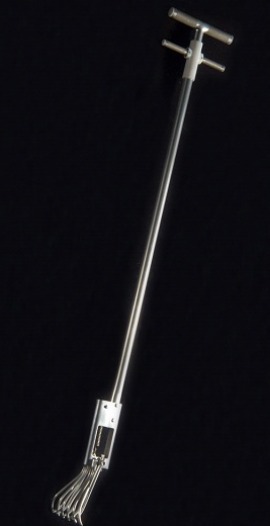
used by the astronaut while in a standing position to pick up samples from pebble size to fist size. The tongs are also used to recapture equipment the astronaut may inadvertently drop.
This tool is 81 cm (32 inches) long overall
The tines of the tongs are made of stainless steel and the handle of aluminum
The tongs are operated by squeezing the T-bar (grips at the top of the handle to open the tines).
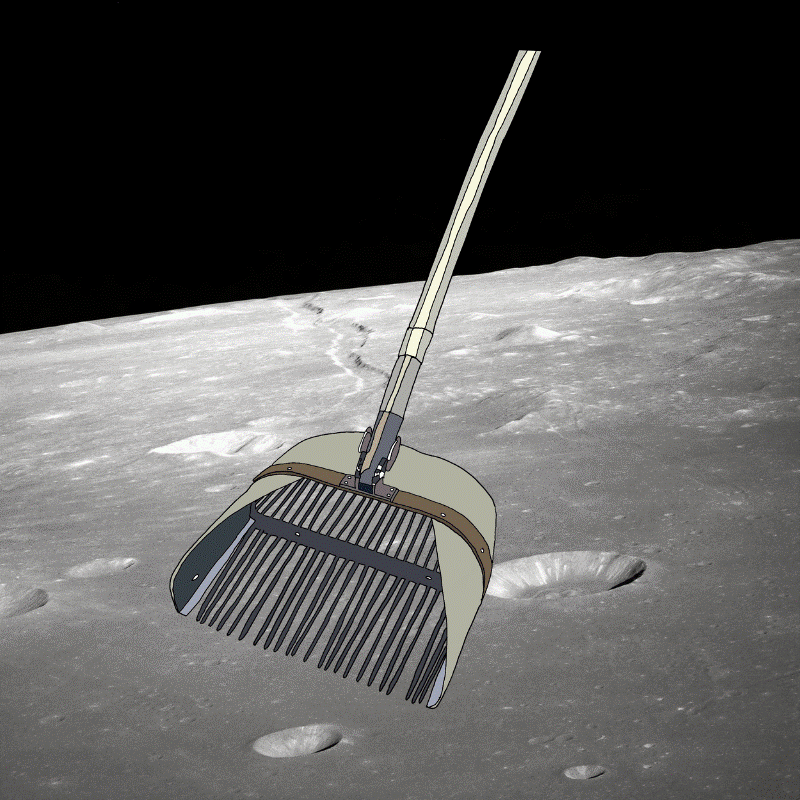
The rake is used to collect discrete samples of rocks and rock chips ranging from 1.3 cm (one-half inch) to 2.5 cm (one inch) in size.
The rake is adjustable for ease of sample collection and stowage. A handle, approximately 25 cm (10 inches) long, attaches to the extension handle for sample collection tasks
The tines, formed in the shape of a scoop, are stainless steel.

The scale is used to weigh the loaded sample return containers, sample bags, and other containers to maintain the weight budget for return to Earth.
The scale has graduated markings in increments of 5 pounds to a maximum capacity of 80 pounds. The scale is stowed and used in the lunar module ascent stage.

to connect all the tools together
The handle can extend up to 3 meters so that it can extend the astronaut's reach to permit working access to the surface. The lower end has a quick-disconnect mount and lock designed to resist compression, tension, torsion, or a combination of these Loads. The upper end is fitted with a sliding "T" handle to facilitate any torqueing operation
This tool is made of aluminum alloy tubing with a malleable stainless-steel cap designed to be used as an anvil surface.

it is used to increase the range of a person's reach when grabbing objects from the surface.
It is made of stainless-steel

The sampling scoop is used to collect soil material or other lunar samples too small for the rake or tongs to pick up.
The Stainless-Steel pan of the scoop, which is 5 cm (2 inches) by 11 cm (41/2 inches) by 15 cm (6 inches) has a flat bottom flanged on both sides and a partial cover on the top to prevent loss of contents.
It’s pan made of stainless steel
It is a spectrometer that analyses the chemical element composition of a sample (Martian rock or soil surface) from the scattered alpha particles, and fluorescent X-rays after the sample is irradiated with alpha particles and X-rays from radioactive sources.
it is about the size of a cupcake.
It measures the type and amount of harmful radiation that reaches the Martian surface from the sun and space sources. This information helps shape future human missions to Mars by letting us know how much shielding from radiation future Mars astronauts will need to protect them.
Similar to a small toaster or six-pack of soda
Consists of a charged particle telescope comprised of three solid-state detectors and a cesium iodide (CsI) calorimeter.
ChemCam's laser, camera and spectrograph work together to identify the chemical and mineral composition of rocks and soils.
Telescope:Focuses laser and camera
Remote Micro-Imager:One of Curiosity's "eyes," captures detailed images of the area illuminated by the laser beam
Laser:Vaporizes rock surfaces, creating a plasma of their component gases
Spectrometer:Three spectrographs divide the plasma light into wavelengths for chemical analysis
copy-right © All Rights Reserved From E.D.I.T.H Team